Furcadia's Fading Memories
Posted by brilokuloj on May 8, 2026
Furcadia is the Guinness World Record holder for longest consecutively running MMORPG. This piece of trivia is the only thing it really has going for it right now, and it’s the leading sentence any discussion of it will open with. Depending on who you ask, Furcadia has either been dead since 2010, or it’s “still going strong, totally”. Here’s just a sample:
Dead:
- Furcadia is Dead (2011)
- “But my fear is growing that furcadia is dying.” (2016)
- “This game is sinking and I don’t think it will ever revive.” (2017)
- “The problem is that Furcadia is dead” (2018)
- “I hate to admit it but Furcadia is dead.” (2018)
- “Furcadia is dead in the water.” (2020)
- “This game will be dead within the next 2 years” (2020)
- “Long ago it was a lively place […] now Furcadia is dead.” (2020)
- “Furcadia has been dead a long time although the staff won’t admit it.” (2021)
Alive:
- “I will say that the traffic is definitely lacking but it isn’t dead yet.” (2021)
- “The community is smaller than in years past but also more mature and steady” (2024)
- “Furc isn’t nearly as big as it used to be […] but it’s not dead yet!” (2025)
Inarguably, the community is smaller and more insular, which doesn’t have to be a bad thing or mean that it’s dead. And what does it matter either way? It’s just going to keep going until it doesn’t anymore. Furcadia keeps running because people sunk real-world money into the game and will probably continue to do so. At the same time, they only continue to spend money on it because they had done so in the first place. It’s Sunk Cost Fallacy: The Game.
In this context, when I say it is Dying For Real, I mean that its community has finally begun to cannibalize itself. The message is clear: the established playerbase does not want Furcadia to live, outside of the very small cliques they have made. There is no further growth that can happen.
Heydays
I will not bore you with the entire history of Furcadia. I have written enough about it as it is. For the purposes of this article I will say a few things that will become important context later.
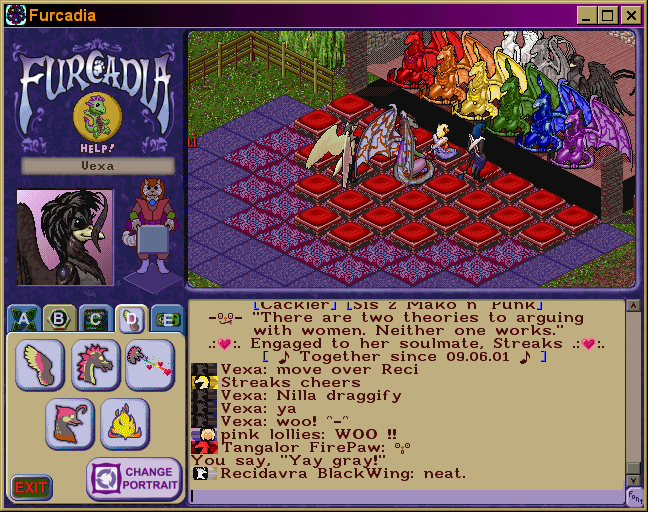
Furcadia began in 1996 as a “graphical MUD”, essentially a roleplay chatroom with avatars that could move around on the screen. It launched bare-bones as a proof-of-concept, but quickly picked up in popularity, and then it did what few other games would do: it facilitated user-created content. Furcadia introduced a map editor, and not only could you create your own maps to run around in, but you could also upload them to the main server in the form of portals on the hubworlds that people could walk into.
All of this might sound familiar to you if you have ever played VRChat, but this was revolutionary stuff back then. You didn’t need to get your account verified and you didn’t even have to pay for anything! In 10 minutes (give or take dialup internet times), you could log in, make a map, upload it to the server, and invite your friends.
Furcadia peaked in 2007 with a record of 4,920 concurrent users, and it’s spent the rest of its life chasing that high to no avail. From personal experience, I would say that Furcadia had experienced its biggest popularity during 2000-2004, and that its player record 3 years later was a byproduct of the game’s burgeoning “alt account” market. But perhaps I am bitter because my own roleplay groups had dissolved by 2007.
In 2012, its active playerbase had at least halved, and they did the untertaking of launching a kickstarter for “The Second Dreaming”. This was an update that promised to bring long-awaited features to the game. The first half of the update launched in 2016, the second half never came, and the game’s playerbase continued to dwindle.
Fading Memories
Despite its record-holding longevity, Furcadia archival has been few and far in between. Most of what happened in Furcadia took place in the game itself; from there, it spread out to the public web slowly and sporadically. Screenshots would be taken, then stowed away on personal websites. The Furcadia website itself kept a sparse collection of data on guilds and events. Most of these things would be washed away.
For most of Furcadia’s lifespan, the most accessible historical archive has been Furcadian.net, run by Jackie of VideoGameSprites; this repository hosts 12,336 sprites, along with captures of all of the main maps from 1996 to 2012. Not far behind is the Furcadian Historical Society, which hosted nearly 200 raw map files for download, but did not host images; with the death of Angelfire, it is now only accessible via the Wayback Machine.
Furcadia’s chances at being even just a fond memory were going downhill fast. On October 18, 2018, they shut down the community forums with little warning. This was one of Furcadia’s last reaches into the public internet, and now it was gone. The only public forum left was the inactive Furcadia subreddit, which mostly told people to join a fanmade Discord server.
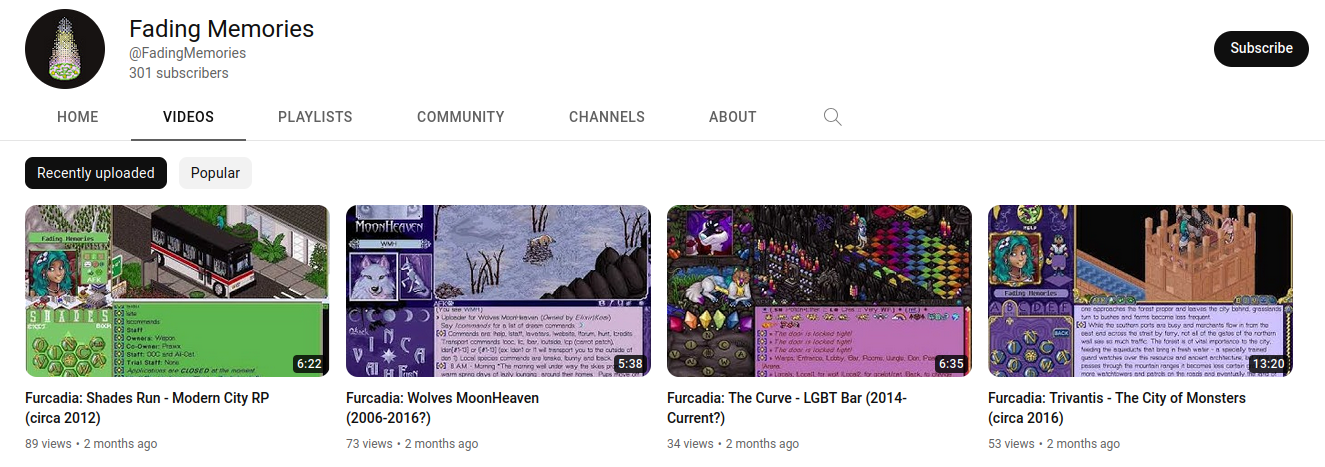
All of this would change in late 2019, when a Reddit user named DistantDustyDreams would post a thread titled “Seeking: People who have old computers Furcadia is installed on, but Furc hasn’t been opened for a long time on.” Not long afterward, an account named Fading Memories began uploading videos to YouTube – walkaround tours of old maps.
Due to the roleplay-focused nature of the game, it’s typical for Furcadians to play multiple accounts, sometimes even at the same time. That’s why I’m certain Fading Memories would have had a pre-existing account, maybe one that they played more often, but I don’t think speculating on their “real identity” is appropriate. What is known about them is that they have a passion for Furcadia and show respectable writing skill. Some of their Reddit posts alluded to a historical familiarity with Imaginarium, a more serious roleplaying location in Furcadia.
Fading Memories, though anonymous, quickly became a participating and active member of this dwindling online community. They had a repository of maps that they would upload, including “Allegria Island of the Past” and “Imaginarium of the Past”, recreations of what popular hubworlds looked like at the peak of the game’s popularity. You could frequently find them idling in the Allegria Island hub. On Reddit, they would go out of their way to find posts about popular MMOs and remind others that Furcadia was still up and running. They even ran small events that encouraged others to log onto the game and explore maps in return for paid-currency ingame items.
They recorded hours of footage of this game. There is at least one YouTube essay about Furcadia that just uses Fading Memories’ footage as its backdrop. People would come into the comments sections of these tour videos to talk about how they remembered the map in question, their experiences there, et cetera; Fading Memories would talk to them, give any information they had, and ask if the person had a copy of Furcadia on an old laptop anywhere. (These Furcadia installations frequently stored cached unencrypted files for maps that the player had entered.)
Everyone who cares about Furcadia has a unique experience with it, and most of them think that they’re the only person that truly cared about the game and its chance at a future. I’m one of those pretentious people. Fading Memories was special, because they were the only person I could confidently say cared more than me. I run the only modern Furcadia historical archive, but Fading Memories ran the largest.
Fading Memories was concerned for the game’s well-being and chances at any further progression. They made several posts analyzing the loss of the forums, the failures of the Kickstarter, and what could be done to bring people in. This breathed a lot of life back into the community. Like, a lot. It got me back into it. I had dropped the game in 2010 when I had migrated onto (shudder) Tumblr, and I hadn’t touched it in a decade, but seeing them upload these videos – devoid of the drama and trauma I associated with the game, dedicated solely to the environments I remembered – gave me an opportunity to reconnect with memories. I saw plenty of others saying the same thing.
The channel took off fast, at least compared to how glacially slow the game’s community had been moving in the prior decade. In 2024, Fading Memories would try something new: alongside their tour videos, they also began posting full map .png exports to Reddit. These were received well, and they were actually what finally inspired me to start doing my own archival work for the game.
On June 27, 2025, Fading Memories made their last post. This was a full map export of Asheville by Night, a roleplay map in the World of Darkness setting. Not long afterward, they took down their entire internet presence.
A Reddit thread was made in July, asking where they had gone. They replied from a new account, “retireddust”:
It appears you are a Furcadian reaching out to me regarding the project. Any positive association with dabbling in the preservation of lost media and history has been eclipsed by complicating factors. You may read them using this pastebin link, though I do not believe it to be worth your time.
Let’s check out that Pastebin link.
The document
It turns out that for the past several years, Fading Memories had been the subject of harassment, which they had silently dealt with until it had become too much to bear. This is a 15-point bulleted document detailing only the worst of the things they’ve seen said about them.
A frequent topic in this document is the idea that Fading Memories is entitled and demanding. Every accusation to this effect – and these accusations make up the bulk of the text – is based on a couple of mis-remembered conversations, as well as not only the person’s reluctance to say “no”, but their willingness to outright lie and say “that’s fine” and add smiley faces to their conversation only to stew on it later. This is passive aggression from the community I am well familiar with.
One of the reasons for this fixation on FM’s “demandingness” is because of Furcadian culture’s preoccupation with the sanctity of Patch Rights. Patches are a broad term for any player-created art, from avatars to floor tiles and so forth. Patches are also, more often than not, compilations of pre-existing graphics that weren’t made by the map creator. More on that later.
SleepySolace, owner of the feral roleplay map Outlands, claimed that Fading Memories harassed her insistently for her map’s patch art. On top of that Outlands’ patches weren’t original in the first place, Fading Memories also attaches the full length of their singular conversation, where they sent a whopping total of 4 messages and left.
An anonymous user claimed that their map “could not be uploaded” without a bot that belonged to another user. Fading Memories tried to correct this misconception and this was written off as harassment. You will quickly notice that any form of communication from FM will be portrayed as harassment.
Muunokhoi, at-the-time owner of historical map The Golden Tether, claimed that Fading Memories had stolen a copy of TGT from them and uploaded a tour video with a disrespectful and mocking description. What had actually happened was that Fading Memories had acquired a copy of TGT from long before Muunokhoi’s involvement (the map had changed hands many times through its life) and given it to them. FM then recorded a tour video to see if they could get in contact with the original map creator, which they did, and the creator had no problems with the video. This misunderstanding formed the basis of the rumor that Fading Memories could steal modern maps.
(Also, the deeply insulting caption was… “So old yo’ mama used to go here.”)
One accusation is that Fading Memories was dedicated to portraying Furcadia as if it is dying. To which I say: LOL. LMAO, even.
Peep, owner of Snowside Peak, participated in a conversation of accusations against FM and continued to help spread the rumor that Fading Memories had access to a modern decryptor. This rumor is based in that FM did occasionally decrypt maps from the early 2000s for historical purposes, but only maps that had not been seen since then; FM was consistent to not “steal” any modern maps. Not that they could even if they wanted to – the map and graphics encryption changed in the 2010s and a new decryptor was never made.
Another rumor going around was the idea that FM would not remove videos if asked to do so. This was not true to start with, but appeared to be based on an incident where FM had made the mistake of changing a video to Unlisted instead of Private; at this point, they were sent a DMCA request, which they responded to in order to keep their channel in good standing.
Syk, creator of The Dog Adoption Center, posted in the dogpile that they did not feel safe to ask Fading Memories to remove their map because they believed FM was “extremely confrontational”. Silvered Raincloud and Eros Thanatos also contributed to this by claiming that FM had harassed community members for details about Idavollr, a map that apparently closed due to the owner facing harassment targeting their… 3 year old child? The implication being, of course, that FM was endangering a child by asking why a roleplay group had suddenly collapsed.
Silvered Raincloud was the original owner and creator of Cirrus Star Rabbit Homes, a map that Fading Memories toured on both YouTube and Reddit. As with many other maps that are the topic of this harassment campaign, CSRH was sold in the late 2000s and changed hands many times until it was long out of Silv’s rights. Nevertheless, Silv claims that FM had stolen CSRH from them, despite that Silv had approved the original tour video – and also that Silv did not have the rights to CSRH anymore, and had not owned it for more than a decade.
The number one accusation is that Fading Memories does not respect copyright law.
Copyright law in Furcadia
Do you know what a MIDI is? If you’ve done any electronic music you might recognize the term in a different context. MIDI is a way of transcribing music digitally, essentially. In this case, “a MIDI” refers to a file that contains that music data, which can be played back by a computer with a “soundfont” (a collection of instrument samples).
All of this might be easier to understand if you’ve ever seen a player piano, or even just the tines on a music box. The MIDI is the piano roll, here.
MIDIs were an exciting technology in the 90s for a lot of reasons. One of those was that they were a way to store a lot of songs that you could listen to at any time on your computer. I have 2,000 MIDIs in my personal collection, which adds up to 32 MB. That’s the size of a 30-minute MP3. My MIDI collection is 43 hours long.
Another reason the MIDI was beloved is because they were (comparatively) easy to make for people with no other means to make music. Computers were expensive, but they were frequently the lower-class American family’s one big investment. I knew a lot of people who couldn’t afford instruments or lessons, but they could download Cakewalk and noodle around.
This brought a lot of people into music. Unfortunately, like many other online art forms, it was hard for them to bring attention onto their original creations, and so they took to making fanart of geek media; in this case, covers of songs from games such as Final Fantasy and Banjo-Kazooie. Which brings me back to Furcadia.
I have a spreadsheet where I have been working to identify 327 MIDIs distributed in the freely-available Furcadian maps and patches I have archived. So far, I have identified 228, of which 3 are original compositions (i.e. not covers), and none of those 3 were made by the Furcadian for their map that they were distributing. Every single other one was a copyrighted song – not just that, but a cover of a copyrighted song, and that cover was used without any credit to the person who covered it either.
I don’t know how many people thought about the effort that goes into these – and I did say they were comparatively easy, but that’s compared to having a recording setup and a good guitar and a way to distribute your music to people with dialup connections. We’re still talking about hours of work, and oftentimes what I could compare to a “pixel-by-pixel” approach, as these people didn’t always have access to MIDI pianos they could hook to their computer and record, so they would be individually placing and adjusting the length and volume and panning of notes.
With all that said, the idea of crediting a MIDI was almost unfathomable, because MIDIs were just something you downloaded in bulk off of established MIDI-hosting websites. These sites would often have credits, but it was just kind of white noise. The credits were rarely included in the filenames, if even within the file at all (MIDI had no real space for credit metadata so people would write their info in the names of the instruments). By the time it would make its way into Furcadia, a file would be renamed to ‘m11.mid’ to be compatible with the game’s scripting language, and the credits would never be displayed.
MIDIs really were a great way to add texture to maps. They were also the easiest way for me to listen to new music. One of the funny things I remember sometimes is that Furcadia never really had a music loop function, so since I occasionally used it as a glorified MIDI player, I would have to exit and re-enter a map in order to play the MIDI again. This did incentivize me not only leaving the game open but also periodically checking in on it every few minutes.
When I first joined Furcadia, I integrated quickly into a fandom roleplay group. The map we spent the most time in had a pool area that played the MIDI “SMSRiccoHarbor.mid”, a cover of Super Mario Sunshine’s Ricco Harbor sequenced by Dave Phaneuf. It’s a decent recreation, if kind of shrill. When I finally played Super Mario Sunshine for the first time over a decade later, I didn’t find myself thinking about that pool at any point, but the MIDI sends me back there instantly.
With Furcadia’s ease, I was quick to figure out how to make my own maps. The first one I made was “Nariko”, a town with a hotel and a Taco Bell. It was a rite of passage to make a Furcadia map that was some form of inn, so in order to make my map stand out in any way, I went on the hunt for adequate MIDIs. The one I ended up choosing to permanently represent my map was “Spyro_marketmesa.mid” by Alop. I didn’t care much for Spyro: Season of Ice, the game that Market Mesa came from. (In fact, I didn’t like the game at all, though that made me feel weirdly guilty as my parents had spent money on it for me in the hopes that I would like it.) But this particular song was pleasing to me, and there was a MIDI cover of it.
Dave Phaneuf continues to post on the internet as Dave Does Music, where it appears he does anime covers now. But Alop appears to have vanished. It’s likely they just took a change of username at some point, but any traces of them are not on the surface-level Internet. This is the kind of thing that happens with early Internet art, and why even keeping the most minimal of records is important.
I would like to thank Alop, if I could, but I have a feeling they would not understand and it would be an uncomfortable interaction for the both of us. MIDIs in Furcadia were taken so far outside of their original context: from a composition, to a MIDI sequence, to a Furcadia map, where it lives as a representation of talking to a friend group, something like a specific air freshener set in a waiting room.
But MIDIs were not the only thing repurposed on Furcadia. There was also any kind of pixel art you could imagine. Video games were cannibalized upon launch by “sprite rippers”, and while you might associate these primarily with “sprite comics”, Furcadia was also a massive client for any form of artwork that could be fit into the game’s limitations.
I once found myself in the middle between a war of two maps I went to, one of which claimed to be the first to have used a specific sprite and that the other map had stolen it. Neither of them had ownership over this piece of pixel art, and it was extremely unlikely that either of them had even been the one to rip it out of the game it was from.
But don’t just take my word for it! Why not take a tour of the official Furcadia patch archive, where you can find gratuitous use of IPs such as:
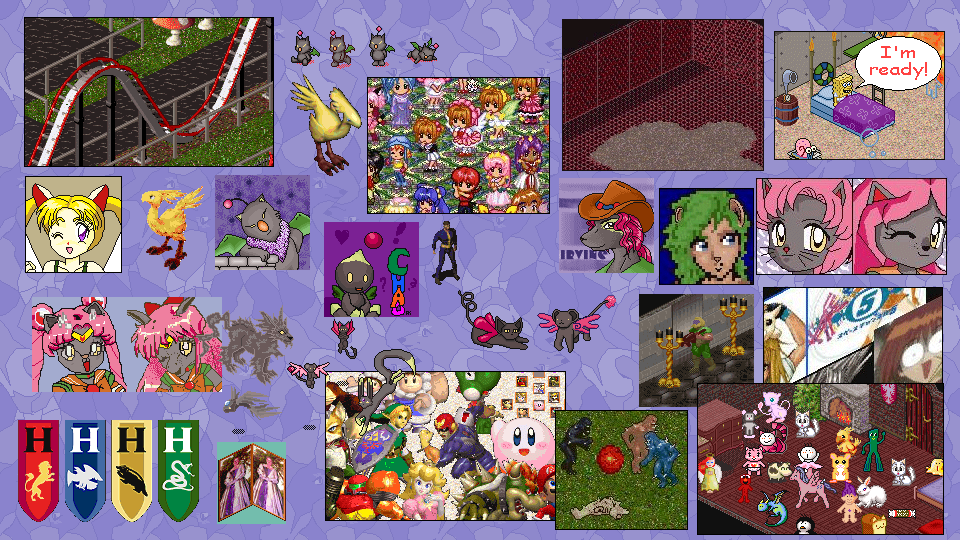
- Cardcaptor Sakura
- Cowboy Bebop
- Counter Strike
- Fallout
- Final Fantasy
- Habbo Hotel
- Half-Life
- Harry Potter
- The Legend of Zelda
- The Lord of the Rings
- Neon Genesis Evangelion
- Pokemon
- Ragnarok Online
- Rollercoaster Tycoon
- Sailor Moon
- Secret of Mana
- Silent Hill
- Sonic the Hedgehog
- SpongeBob SquarePants
- Starcraft
- Star Trek
- Super Smash Bros
- Vampire Hunter D
You might wonder if maybe this is okay, since it’s technically just fanmade content they are being gracious enough to host. However, the official Rameen Festival map on Furcadia – still used to this day! – features a piece taken directly from Rollercoaster Tycoon, which in turn they had borrowed from this very same patch archive: a Furcadian took art from a licensed video game, and the staff themselves benefited from this behavior.
Is that still not enough? How about that in the character creator you’re greeted with upon starting the game, rabbits are referred to as Lapines, a term borrowed from the 1972 xenofiction novel Watership Down? Furcadia itself is built on derivation.
To be clear, I think this is great. Aside from my brief dips into petty “finders keepers” playground fights, I feel like I benefitted greatly from being in an environment so conducive to what was effectively collage art. People weren’t afraid to talk about their artistic influences. Moving onto deviantART and more “professional” illustrator spaces (where even referencing photos too closely is a form of evil) was a form of culture shock for me, one which I’ve still suffered from and has made me feel at times like I do not enjoy the process of art at all.
Furcadia, by its nature from the very beginning, is a space where copyright law is and has always been moot, if not an outright taboo topic. If copyright were to be seriously enforced on the platform, it would come down like a house of cards. Furcadia does now offer support for content licensing, where it says that all content uploaded without a chosen license is licensed under Furcadia’s equivalent to CC0 – meaning that any rights to long-term historical maps are extremely dubious, as this simply wasn’t even a concern for most creators at the time.
Furcadia is Dead
All of this has weighed heavily on my mind for nearly a year now, ever since Fading Memories left the community. I have checked in every month for any update, any sign that they might change their mind or that another player might be ready to take up the mantle. There has been no progress.
My heart broke last week when I went onto Reddit for my usual check-in and discovered that Fading Memories had edited their post to point to a new link for The Document: apparently, months later, someone or someones had taken it upon themself to abuse the report feature until The Document had been removed. Even though FM has thoroughly left the community and removed any trace of their presence, they are still getting harassment.
I am now content to say that Furcadia is dead, and the game that is being hosted is merely a platform for peddling rudimentary cryptocurrency. I had been getting ready this month to log on and try to document what I could of the annual Spring Festival, but I just don’t have it in me.
Furcadia was made in the 90s by an astoundingly small team, and I have no doubt it could be easily replicated today. Tilemap Town is already off to a great start. Qwook, developer of Last Seen Online, is working on Arcadus. I have my own project. Things will move on. I just wish they hadn’t gone down in flames.
There’s a lot of things I could say about ways that we could avoid repeating the mistakes of Furcadia. I didn’t care for the microtransactions; I wish it had been more roleplay-focused. The players who migrated to Second Life evidently wanted more gambling. Furcadia was just so impossibly broad in scope, for every negative I could say is someone who would have enjoyed it. But I do believe that a community that wishes to sustain itself cannot shoot itself in the foot and hope to live.
To Fading Memories, who will likely never read this: thanks for what you did. You got me into video game archival in general. I understand you have no interest in hosting your collection anymore. I’d love to do it for you; I’d be happy to tank the drama. I’d just do it myself to start with but I don’t have the files or the connections you did, the same connections that ended up blowing up in your face. All I have is a lot of free time and a passion for a game that could have been.
To whoever’s made it this far: this article has been a soul-crushing write for me. I hadn’t been ready to face it, but I think the Fading Memories YouTube project had put a secret hope in my heart that maybe one day Furcadia could become a place of creativity again. I am now facing that this is an impossibility and that I must move on as well.
In closing, here’s a quote from Reddit user annapigna:
I have lost any interest to return and re-engage with furcadia as a whole after this. Your project was pumping new life sap into that game. I just watched from the sidelines what amazing things you and the roamheart team were accomplishing. Seeing new uploads from you always put a smile on my face. I showed old furcadia maps to irl people around me out of the sheer glee of seeing them again. I raved about your project to people offline who couldn’t care less. I now regret not showing my support and appreciation earlier. I am so sorry.
Categories: gaming
Tagged: furcadia
On this day...
- The Chipotle Unexperience (May 8, 2020)
- Panera Bread's Deadly Lemonade will kill no more (May 8, 2024)